7 Hands-On Place Value Activities for 4th Grade
Teaching place value can seem more straightforward than it really is.
Your students may confidently name the ones, tens, hundreds and thousands places. They may fill in a place value chart without any trouble. Then you ask what a particular digit is actually worth-and suddenly everyone needs a little more thinking time.
That is because recognizing a digit’s place and understanding its value are closely related, but they are not the same thing.
Take the number 684,215:
- The digit is 6.
- Its place is hundred thousands.
- Its value is 600,000.
By fourth grade, students are working with larger numbers and exploring how the value of a digit changes depending on its position. They need more than repeated practice naming columns. They need opportunities to build numbers, compare representations, and explain why a digit has a particular value.
These hands-on place value activities for 4th grade can be used during whole-class lessons, math centers, partner practice, or small-group instruction.
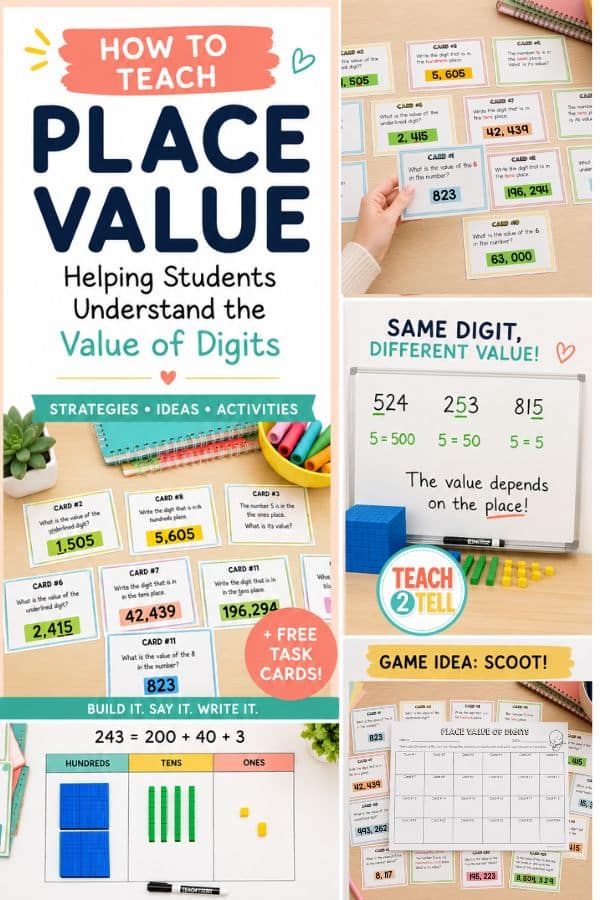
Why Place Value Is So Important in 4th Grade
A strong understanding of place value supports many of the math concepts students encounter in upper elementary school.
Students use place value when they:
- read and write large multi-digit numbers;
- represent numbers in standard, word, and expanded form;
- compare and order numbers;
- round multi-digit numbers;
- use addition and subtraction algorithms;
- multiply and divide by powers of ten; and
- work with decimals in later grades.
The difficulty is that students can become quite good at following a place value procedure without understanding the quantity underneath it.
For example, a student might know that the 4 in 462,731 is in the hundred thousands place. That does not necessarily mean the student understands that the 4 represents four hundred thousands, or 400,000.
The following activities help make those relationships more visible.
1. Begin With Concrete Place Value Models
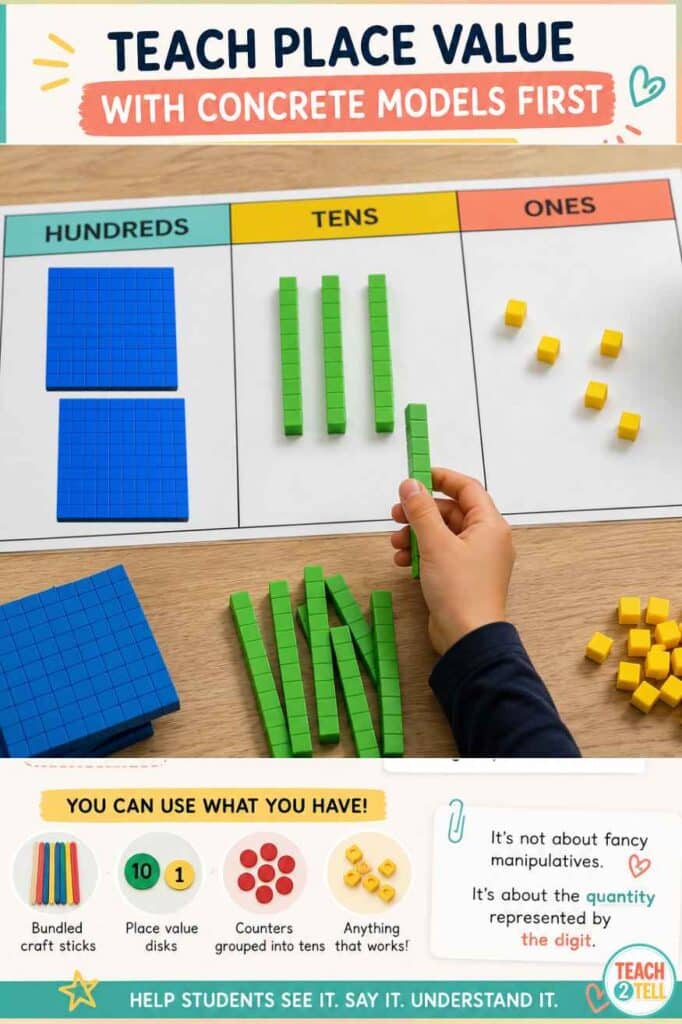
Even though fourth graders work with numbers much larger than the numbers represented by a typical set of base-ten blocks, concrete models still help establish the structure of our base-ten number system.
Begin with a smaller number such as 2,435 and use base-ten blocks, place value disks or bundled materials to show:
- 2 thousands;
- 4 hundreds;
- 3 tens; and
- 5 ones.
As students build the number, ask questions that focus on value:
- What is the 4 worth?
- Why is it worth 400 rather than 40?
- How many groups of 100 does it represent?
- What would its value be if it moved one place to the left?
Once students understand the pattern with smaller quantities, transfer the same reasoning to larger numbers using place value disks or a place value chart.
For example:
243,500
- 2 hundred thousands = 200,000
- 4 ten thousands = 40,000
- 3 thousands = 3,000
- 5 hundreds = 500
Students do not need 243,500 individual blocks on the table—thankfully. The goal is to use the concrete model to establish the pattern and then extend that pattern to larger places.
2. Play Build It, Say It, Write It
This place value activity connects the model, mathematical language, and written number.
Give students a number such as 46,372 and ask them to complete three steps.
Build It
Students represent the number using place value disks, digit cards, or counters placed on a place value chart.
Say It
Students explain the value of every digit:
“The 4 is in the ten thousands place, so it is worth 40,000. The 6 is in the thousands place, so it is worth 6,000. The 3 is worth 300, the 7 is worth 70, and the 2 is worth 2.”
Write It
Students record the number in standard and expanded form:
46,372 = 40,000 + 6,000 + 300 + 70 + 2
This activity works well in a teacher-led small group because you can immediately hear whether students understand the values or are simply reciting the names of the places.
You can also differentiate it easily. Begin with four-digit numbers for students who need additional support and move to numbers through one million when they are ready.
3. Compare the Value of the Same Digit
One of the clearest ways to teach place value is to show the same digit in several different positions.
Write these numbers on the board:
524,816
253,641
815,235
Ask students to find the value of the digit 5 in each number:
- In 524,816, the 5 is worth 500,000.
- In 253,641, the 5 is worth 50,000.
- In 815,235, the 5 is worth 5,000.
The digit has not changed. Its position has changed, and therefore its value has changed.
Follow the answers with the most useful question you can ask during a place value lesson:
“How do you know?”
A student who can explain that the 5 in 253,641 represents five groups of ten thousand is demonstrating much deeper understanding than a student who gives only the answer 50,000.
For partner practice, assign students a digit and ask them to write three numbers in which that digit has three different values. Partners exchange numbers and identify the place and value of the chosen digit in each one.
4. Investigate the Ten-Times Place Value Relationship
Fourth graders need to understand that a digit represents ten times as much when it moves one place to the left.
Write this sequence:
6
60
600
6,000
60,000
600,000
Ask students what they notice about the value of the 6.
Each time the digit moves one place to the left, its value becomes ten times greater:
- 6 tens is ten times the value of 6 ones.
- 6 hundreds is ten times the value of 6 tens.
- 6 thousands is ten times the value of 6 hundreds.
Use a digit card or sticky note with the number 6 written on it. Move it across a place value chart one column at a time. At each position, ask:
- What is the value of the 6 now?
- How does this value compare with its previous value?
- What happens when the 6 moves one place to the right?
Moving the digit physically helps students see that the relationship is connected to its position in the base-ten system.
This is more meaningful than teaching students to “just add a zero.” That shortcut may produce the correct answer in some situations, but it does not explain why the value has changed.
5. Create Numbers With Digit Cards
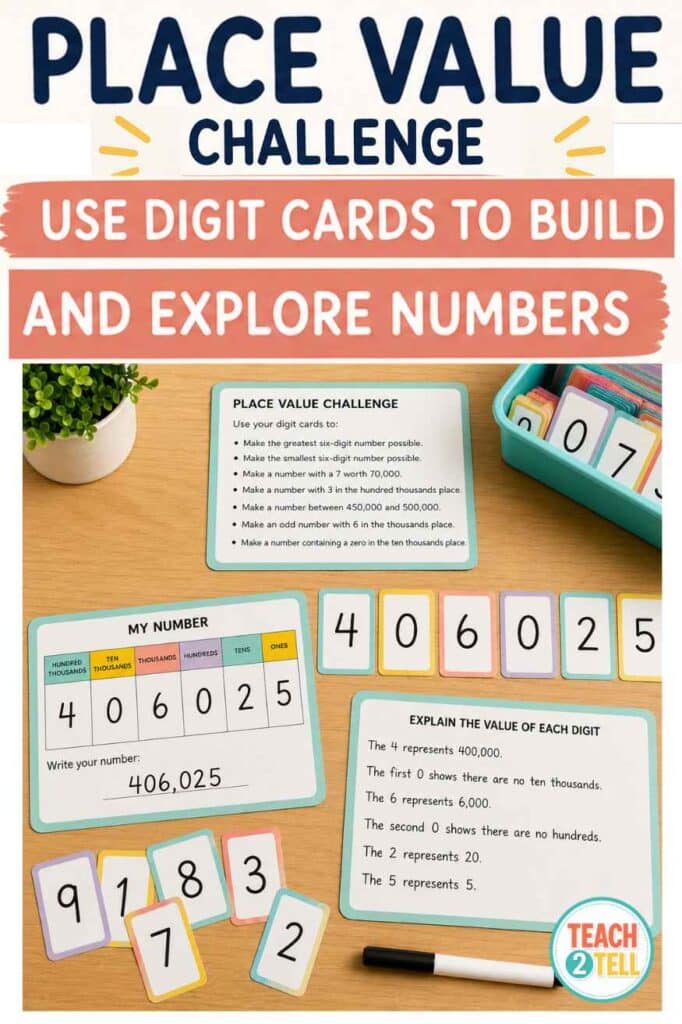
Give pairs or small groups a set of digit cards from 0 to 9. Then call out a place value challenge.
For example:
- Make the greatest six-digit number possible.
- Make the smallest six-digit number possible.
- Make a number with a 7 worth 70,000.
- Make a number with 3 in the hundred thousands place.
- Make a number between 450,000 and 500,000.
- Make an odd number with 6 in the thousands place.
- Make a number containing a zero in the ten thousands place.
Students arrange their cards to make a number that satisfies the clue. They then read the number aloud and explain the value of each digit.
Some challenges will have several possible answers. This creates an opportunity for students to compare their numbers and explain why more than one answer can be correct.
Be sure to include zero in the activity. Numbers such as 406,025 reveal whether students understand zero as a placeholder.
In 406,025:
- the 4 represents 400,000;
- the first 0 shows there are no ten thousands;
- the 6 represents 6,000;
- the second 0 shows there are no hundreds;
- the 2 represents 20; and
- the 5 represents 5.
Zero may not contribute a quantity in that position, but it still has an important job.
6. Match Standard, Word and Expanded Form
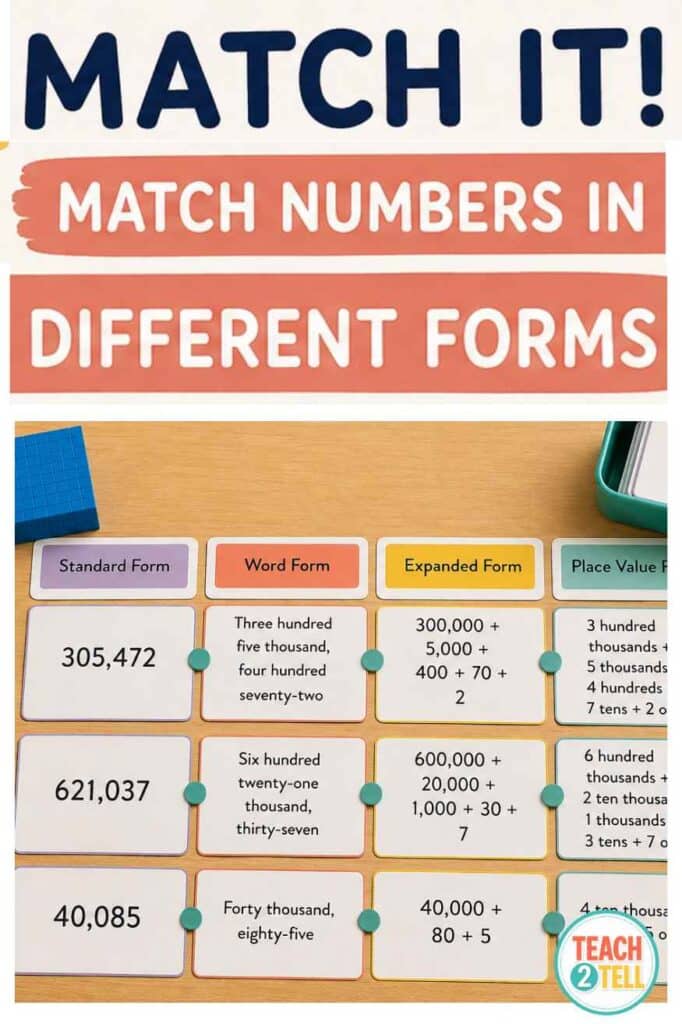
Fourth graders need to recognize that a large number can be represented in different ways without changing its value.
Prepare cards showing numbers in:
- standard form;
- word form;
- expanded form; and
- place value form.
For example, one matching set might include:
Standard form:
305,472
Word form:
Three hundred five thousand, four hundred seventy-two
Expanded form:
300,000 + 5,000 + 400 + 70 + 2
Place value form:
3 hundred thousands + 5 thousands + 4 hundreds + 7 tens + 2 ones
Students work independently or with a partner to find all the cards that represent the same number.
Expanded form is particularly useful for students who confuse a digit with its value. In 305,472, the 5 is not worth 5 or 50. Writing the number as 300,000 + 5,000 + 400 + 70 + 2 makes its value much easier to see.
Include numbers with zeros so students cannot simply match cards by looking for the same sequence of non-zero digits.
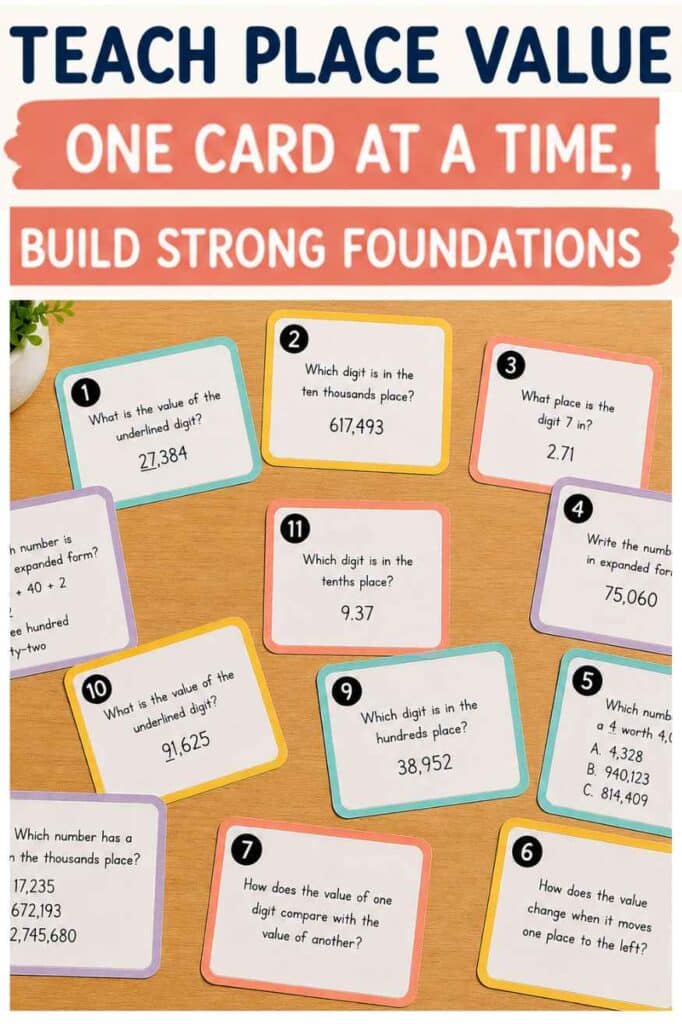
7. Use Place Value Task Cards for Scoot
Place value task cards are a practical way to give students mixed practice after the concept has been explicitly taught.
Place the cards around the classroom and give each student a recording sheet. Students answer the card at their starting position and move to the next one when you call, “Scoot.”
The movement gives students a break from sitting at their desks, but the most important feature is the variety of questions.
Include questions such as:
- What is the value of the underlined digit?
- Which digit is in the ten thousands place?
- What place is the digit 7 in?
- Write the number in expanded form.
- Which number has a 4 worth 400,000?
- How does the value of the digit change when it moves one place to the left?
- How does the value of one digit compare with the value of another?
Mixed questions require students to pay attention to whether they are being asked for the digit, the place or the value.
If every question asks exactly the same thing, students can quickly work out the expected answer pattern and stop reading carefully. A mixed set keeps the mathematical thinking switched on.
Task cards can also be used for math centers, partner practice, small-group instruction, early finishers, or independent review.
Useful Questions for Teaching Place Value
The questions you ask during these place value activities can reveal far more than a completed worksheet.
Try prompts such as:
- What does this digit represent?
- What is the value of the digit?
- How do you know?
- How many groups of 1,000 are represented?
- What would happen if the digit moved one place to the left?
- How does its new value compare with its original value?
- Can you show the number in another form?
- Why is the zero necessary?
- Is there more than one number that could satisfy the clue?
Encourage students to answer in complete mathematical statements.
Instead of saying only “40,000,” a student might explain:
“The 4 is in the ten thousands place, so it represents four groups of ten thousand. Its value is 40,000.”
That explanation shows you that the student understands both the position and the quantity represented.
Common Fourth-Grade Place Value Mistakes
Confusing the Digit, Place, and Value
Take the number 684,215:
- The digit is 6.
- Its place is hundred thousands.
- Its value is 600,000.
Students may use these answers interchangeably, especially when they are working quickly. Mix the wording of your questions so they must decide what information is being requested.
Reading Large Numbers Incorrectly
Students may lose track of place names when reading numbers with five or six digits.
Teach them to separate large numbers into periods using commas:
684,215
Read the thousands period first: six hundred eighty-four thousand.
Then read the ones period: two hundred fifteen.
Place value charts and color-coded periods can provide useful support while students are learning this structure.
Ignoring Zeros Inside a Number
In 507,042, both zeros serve as placeholders.
The first zero shows there are no ten thousands. The second shows there are no hundreds. Removing either zero changes the number and the position of the remaining digits.
Include numbers with zeros throughout your place value practice rather than treating them as a separate set of “tricky” questions.
that doesn’t exist.
Relying on Shortcuts Without Understanding
Students may be told to “add a zero” when multiplying a whole number by ten. While this can appear to work, it does not explain the place value relationship and will cause confusion when students begin working with decimals.
Help students understand that multiplying by ten makes the value of each digit ten times greater. The digits shift into places with greater value because of the structure of the base-ten system.
Thinking a Larger Digit Always Has a Greater Value
A 9 is not always worth more than a 2.
In 294,000, the 2 is worth 200,000, while the 9 is worth 90,000. The digit’s position determines its value.
Comparing repeated digits in different positions helps address this misconception.
How to Check Students’ Place Value Understanding
One simple way to assess understanding is to give students an incorrect statement to investigate.
For example:
Sam says the 8 in 846,215 has a value of 8. Is Sam correct? Explain your answer.
A student with a secure understanding might respond:
“No. The 8 is in the hundred thousands place, so it represents eight groups of one hundred thousand. Its value is 800,000.”
You could also use a short exit ticket:
- What is the value of the 4 in 462,731?
- How do you know?
- Write another number in which the 4 has a value of 40,000.
- What would the 4 be worth if it moved one place to the left?
These questions show whether students can identify the value, explain their reasoning. and apply the ten-times relationship.
Keep Place Value Practice Meaningful
Effective place value activities for 4th grade do not need complicated supplies or hours of preparation.
The goal is to help students connect:
- the written digit;
- its position in the number;
- the quantity it represents;
- the different ways the number can be written; and
- its relationship to the places on either side.
Let students move digits, build numbers, compare representations, and explain their thinking. Include large numbers, zeros and repeated digits so they are applying the concept rather than relying on a familiar answer pattern.
Most importantly, keep asking students what each digit is worth and how they know.
Naming the column is a useful first step. Understanding the quantity represented by that position is what gives place value its meaning.
Free Place Value Task Cards for Grades 4–5
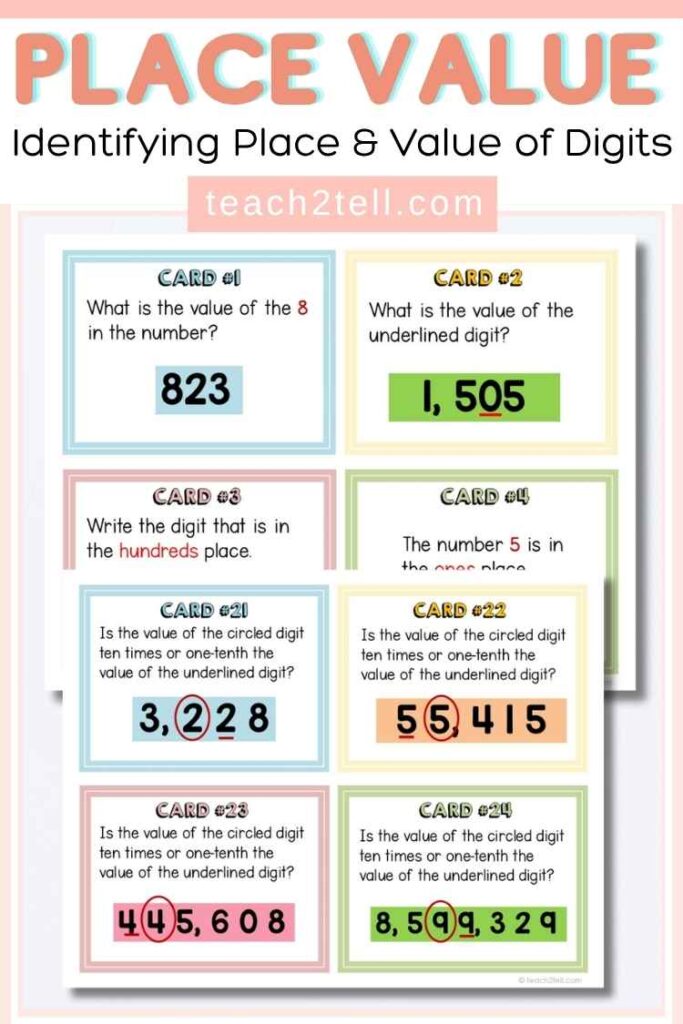
If your students need more mixed practice, you can download these 24 free place value task cards for Grades 4–5.
The cards include practice with:
- identifying digits in different places;
- finding the value of underlined digits;
- distinguishing between a digit, its place, and its value;
- working with numbers from ones through millions; and
- exploring ten-times and one-tenth place value relationships.
You will also receive a student recording sheet and answer key.
Use the cards for Scoot, math centers, partner practice, small-group review, or independent place value practice.
Selected cards may also be used with advanced third graders or during teacher-supported small-group instruction.
CLICK HERE TO GET THE FREE PLACE VALUE TASK CARDS
However you use them, encourage students to go one step beyond naming the place.
The 8 in 846,215 is not simply sitting in the hundred thousands column. It represents 800,000—and understanding why is what helps the rest of place value begin to make sense.
This post on “7 Hands-On Place Value Activities for 4th Grade” was originally shared on TEACH2TELL.COM and has been adapted for Classroom Freebies readers.

Leave a Reply