Engaging children in learning math and English can be a challenging task, but with the right activities, it can become an enjoyable and rewarding experience. One effective way to make learning fun is by incorporating hands-on activities that allow children to explore and interact with the concepts they are learning. For example, in math, activities such as using manipulatives like counting blocks or fraction bars can help children visualize and understand abstract concepts.
Similarly, in English, activities like storytelling, role-playing, and word games can make language learning more engaging and interactive for kids. Another approach to engaging children in math and English is through the use of technology. Educational apps and online platforms offer a wide range of interactive activities that can make learning more enjoyable for kids.
These apps often incorporate gamification elements, such as rewards and challenges, to motivate children to practice math and English skills. By integrating technology into learning, children can access a variety of resources that cater to different learning styles and preferences, making the learning process more personalized and engaging.
Creative Ways to Make Learning Math and English Enjoyable
Creativity plays a crucial role in making learning math and English enjoyable for kids. One creative approach is to incorporate arts and crafts into the learning process. For example, in math, children can create their own geometric shapes using craft materials, while in English, they can make storybooks or write and perform their own plays.
By integrating creative activities into the curriculum, children can develop a deeper understanding of math and English concepts while also honing their artistic skills. Furthermore, incorporating real-life applications of math and English can make learning more relevant and engaging for children. For instance, in math, children can practice measurement and estimation by cooking or baking, while in English, they can write letters or emails to pen pals or create their own newspaper.
By connecting learning to real-world scenarios, children can see the practical value of the skills they are acquiring, which can enhance their motivation and engagement with the subjects.
Making Math and English Exciting and Interactive for Kids
Making math and English exciting for kids involves creating a dynamic and interactive learning environment. One effective strategy is to introduce educational games that reinforce math and English concepts in a playful manner. For example, math games like “Math Bingo” or “Fraction War” can make learning arithmetic and fractions more enjoyable, while word games like “Scrabble” or “Word Search” can enhance vocabulary and spelling skills in English.
By infusing playfulness into the learning process, children can develop a positive attitude towards math and English while sharpening their skills. In addition to games, incorporating multimedia resources such as videos, songs, and interactive online platforms can add an element of excitement to math and English learning. For instance, educational videos can visually illustrate math concepts like geometry or algebra, while catchy songs can help children memorize grammar rules or multiplication tables.
By leveraging multimedia resources, educators can cater to different learning preferences and provide a multi-sensory learning experience that captivates children’s attention.
Incorporating Games to Make Math and English Learning Fun
Incorporating games into math and English learning can significantly enhance children’s engagement and motivation. Games provide a structured yet enjoyable way for children to practice and apply their math and English skills. For example, in math, board games like “Monopoly” or “Settlers of Catan” can reinforce strategic thinking and numerical operations, while in English, games like “Taboo” or “Pictionary” can encourage vocabulary expansion and communication skills.
By integrating games into the curriculum, educators can create a positive learning environment that fosters collaboration, critical thinking, and problem-solving. Furthermore, digital games and online platforms offer a wide array of interactive experiences that cater to different age groups and skill levels. Educational apps like “Prodigy” for math or “Duolingo” for language learning provide gamified experiences that adapt to children’s progress and offer personalized challenges.
By leveraging the immersive nature of digital games, educators can harness children’s natural inclination towards technology to make math and English learning more enjoyable and impactful.
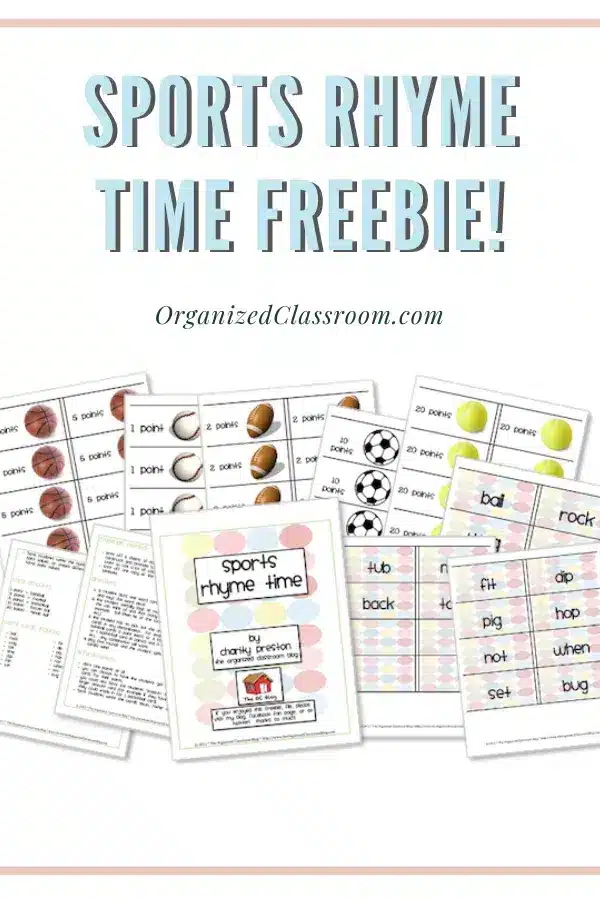
Math and Language Arts Game All Rolled Into One!
Many students love sports of all types. Baseball, basketball, tennis, soccer, and football just to name a few.
So what better way to celebrate that interest than by incorporating it into your lesson plans and learning?
Check out this fun – and free – game I created just for you to do that!
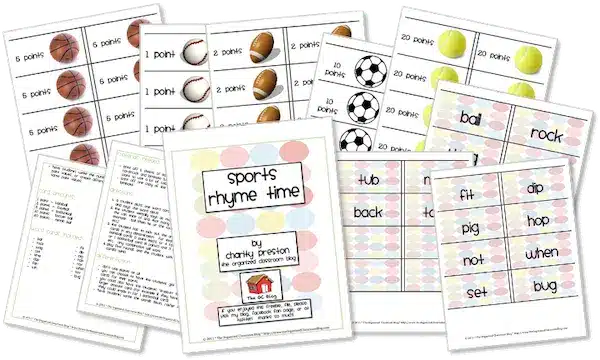
Materials Needed:
- print off 5 sheets of the ball playing cards on cardstock and laminate (use grayscale printing if you do not want to use colored ink)
- print off one copy of the word cards on yardstick and laminate
Directions:
1. A student picks one word card in which to try to make rhyming words and says the word aloud
2. The student verbally says as many words in a row that he or she can think of and that many points are awarded. For example: Ball (then he or she could come up with wall, tall, doll, etc.)
3. The student has to pick out the amount of points from the cards in any denomination. For example: 8 points could be eight baseball cards (1 point each), or four football cards (2 points each), or one basketball card (5 points) and three baseball cards (1 point each). Any combination will work.
4. Play 5 rounds and the student with the most points (not cards) wins!
Differentiation for Card Play
Options for playing this game for different levels:
- Don’t use points at all
- You can choose to have the students get the least amount of cards for their points
- You could also have the students “trade-in” their cards for a larger amount card (for example: If they have 5 baseball cards, they should trade in for 1 basketball card)
- Have students write their words down, rather than saying them orally
- Have students write the number sentences to go with their point values, or create different number sentences for the same point values
Ready to Play?
Grab the free game below and if you are loving this freebie, please share Organized Classroom with other teachers you know. #sharingiscaring

Enjoy! Have another way to differentiate the game for your class? As always, please feel free to add your comments below so that we hear even more fabulous ideas!
~Charity

This post originally appeared at Organized Classroom.



Leave a Reply