Understanding the author’s purpose is crucial for developing strong reading comprehension skills. When students are able to discern why an author has written a particular piece, they can better comprehend the text’s underlying message and intent. Whether the author’s purpose is to persuade, inform, entertain, or a combination of these, recognizing it allows readers to engage with the material more critically.
By understanding the author’s purpose, students can also evaluate the credibility and reliability of the information presented, which is an essential skill in today’s information-rich world. Moreover, being able to identify the author’s purpose enhances students’ ability to make connections between different texts and draw inferences about the author’s intentions.
Key Takeaways
Empowering students to create their own persuasive writing pieces can help them apply their knowledge of author’s purpose in a practical way.
Understanding the importance of author’s purpose is crucial for improving reading comprehension.
Using PIE (Persuade, Inform, Entertain) can help students analyze texts and understand the author’s intentions.
Teaching students to recognize and evaluate persuasive techniques in texts is essential for critical thinking.
Incorporating author’s purpose into reading and writing activities can enhance students’ understanding of texts.

Strategies for Teaching Author’s Purpose in the Classroom
Incorporating various strategies into classroom instruction can effectively teach students how to identify and analyze an author’s purpose. One approach is to use real-world examples of persuasive, informative, and entertaining texts across different mediums such as articles, advertisements, speeches, and literature. By exposing students to diverse texts, educators can help them recognize the distinct characteristics and language used in each type of writing.
Additionally, guiding students through close reading activities that prompt them to consider the underlying motives of the author can deepen their understanding of author’s purpose. Encouraging students to ask questions such as “What is the author trying to achieve?” and “How does the author’s language and tone reflect their purpose?” can foster critical thinking and analytical skills.
Using PIE (Persuade, Inform, Entertain) to Analyze Texts
The PIE acronym—Persuade, Inform, Entertain—serves as a useful framework for analyzing and categorizing different types of texts based on their author’s purpose. When teaching students to use PIE, educators can provide them with examples of persuasive texts that aim to sway the reader’s opinion or behavior, informative texts that seek to impart knowledge or convey facts, and entertaining texts that are designed to engage and amuse the audience. By categorizing texts using the PIE model, students can develop a clearer understanding of how authors employ specific language, structure, and rhetorical devices to achieve their intended purpose.
This approach not only helps students recognize the primary purpose of a text but also encourages them to consider how authors may blend multiple purposes within a single piece of writing.
The Power of Persuasion: Teaching Students to Recognize and Evaluate Author’s Intentions
Teaching students to recognize and evaluate an author’s intentions when employing persuasive techniques is a valuable skill that extends beyond reading comprehension. By honing their ability to identify persuasive language and rhetorical strategies, students become more discerning consumers of information and are better equipped to navigate the complexities of media and advertising. Educators can guide students in deconstructing persuasive texts by highlighting techniques such as emotional appeals, loaded language, repetition, and appeals to authority.
Through close examination of these techniques, students can develop a critical awareness of how authors use language to influence their audience and can assess the effectiveness of these strategies in achieving the author’s intended purpose.
Incorporating Author’s Purpose into Reading and Writing Activities
Integrating author’s purpose into both reading and writing activities can reinforce students’ understanding of how purpose shapes the construction of a text. For instance, educators can design assignments that require students to analyze a given text’s purpose and then respond by crafting their own piece with a specific purpose in mind. This reciprocal process allows students to apply their knowledge of author’s purpose in a practical context, fostering a deeper appreciation for how purpose influences their own writing as well as that of others.
Furthermore, incorporating author’s purpose into reading comprehension activities encourages students to approach texts with a critical eye, prompting them to consider not only what is being said but also why it is being said.
Teaching Students to Identify and Analyze Persuasive Techniques in Texts
Empowering students with the ability to identify and analyze persuasive techniques in texts equips them with valuable skills for engaging with a wide range of written material. Educators can guide students through exercises that involve identifying specific persuasive techniques within texts, such as identifying instances of loaded language or recognizing logical fallacies. By dissecting these techniques, students gain insight into how authors construct persuasive arguments and how they can critically evaluate the validity and effectiveness of these arguments.
Additionally, engaging students in discussions about the ethical implications of persuasive techniques fosters a deeper understanding of the responsibilities that come with wielding persuasive language.
Empowering Students to Create Their Own Persuasive Writing Pieces
Encouraging students to create their own persuasive writing pieces not only reinforces their understanding of persuasive techniques but also cultivates their ability to craft compelling arguments. By providing students with opportunities to write persuasively on topics that are meaningful to them, educators can nurture their ability to articulate their thoughts effectively and advocate for their viewpoints. Through this process, students gain firsthand experience in employing persuasive language and structuring arguments to achieve a specific purpose.
Moreover, empowering students to create persuasive writing pieces fosters confidence in their ability to communicate persuasively, preparing them for success in academic, professional, and civic contexts where effective persuasion is essential.
Teaching author’s purpose in the classroom is a fundamental aspect of developing students’ reading comprehension skills and critical thinking abilities. By guiding students in understanding the importance of author’s purpose, employing effective teaching strategies, and integrating author’s purpose into reading and writing activities, educators can empower students to recognize and evaluate an author’s intentions while also equipping them with the skills to create their own persuasive writing pieces.
Through these efforts, students develop a deeper appreciation for how purpose shapes written communication and become more discerning consumers and producers of written material.
FAQs
What is author’s purpose and why is it important in reading comprehension?
Author’s purpose refers to the reason why an author has written a piece of text. The three main purposes are to persuade, inform, or entertain (PIE). Understanding author’s purpose is important in reading comprehension because it helps readers to analyze and interpret the text more effectively, and to discern the author’s intentions and message.
What are some strategies for teaching author’s purpose in the classroom?
Some strategies for teaching author’s purpose in the classroom include using the PIE (Persuade, Inform, Entertain) framework to analyze texts, providing students with a variety of texts to analyze, discussing and identifying persuasive techniques used by authors, and engaging students in discussions about the intentions of the author.
How can author’s purpose be incorporated into reading and writing activities?
Author’s purpose can be incorporated into reading and writing activities by having students analyze the purpose of various texts, encouraging them to identify and analyze persuasive techniques used by authors, and empowering them to create their own persuasive writing pieces.
How can students be taught to recognize and evaluate author’s intentions?
Students can be taught to recognize and evaluate author’s intentions by engaging them in discussions about the purpose of different texts, providing them with opportunities to analyze and interpret various texts, and encouraging them to critically evaluate the persuasive techniques used by authors.
What are the benefits of teaching students to identify and analyze persuasive techniques in texts?
Teaching students to identify and analyze persuasive techniques in texts helps them to become more critical readers, enhances their understanding of the author’s intentions, and empowers them to become more effective communicators in their own writing.
More Free Teaching Tips!
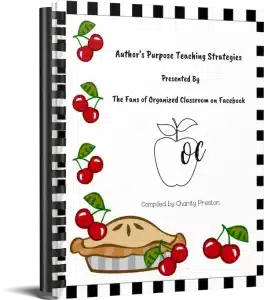
As a thank you for all your hard work during the week and more, here is a compiled eBook that is filled with different ideas for teaching author’s purpose!
Thanks to the fans of Organized Classroom’s Facebook Fan Page for collaborating on yet another fantastic resource that can be used by teachers all over the world!
Feel free to print it out, slap in a 3-prong folder and place in a staff lounge for all to share.
Now go enjoy a nap or a nice walk – both good for you.
~Charity

This post originally appeared at Organized Classroom.



Leave a Reply