Developing good writers is a process that is on a continuum.
This is not something a first grader can grasp and automatically know how to do, and the process is not taught ever again within the next 11 years of school.
Teaching the writing process is something that is taught every year a student is in school. Developing writing skills is a process that evolves over a child’s 12 to 16 years of school.

Read more; write better
Writing process activities could include learning new and innovative vocabulary, sentence structure and thought processes. Research indicates the more a student reads, the better their writing becomes. Teaching these skills throughout a child’s education helps them be better writers post-secondary.
Writing is still KING!
Regardless of whether a student is college bound or not, in our modern technical society, writing is still King! Students who are still struggling with the writing process should always follow the 5 steps.
There are some students who do not need to physically follow these steps, for some students, writing is innate, just like breathing. They are still following these steps, as any good writer will, but they may be able to prewrite and draft during the same step.
Developing Writing Skills: How a Writer’s Workshop Can Help
A writer’s workshop plays a vital role in improving students’ writing skills through guided instruction and practice, students learn the fundamentals of writing, such as grammar, sentence structure, and organization.
They also explore different genres and styles of writing, allowing them to develop their unique voice as writers.
The workshop format encourages students to actively engage in the writing process, from brainstorming ideas to revising and editing their work.
In a writer’s workshop, students are exposed to various writing exercises and techniques that help them refine their skills.
These exercises may include freewriting, where students write continuously without worrying about grammar or punctuation, or guided prompts that encourage them to explore different perspectives and themes.
By practicing these techniques regularly, students become more comfortable with the writing process and develop a deeper understanding of how to effectively communicate their thoughts and ideas.
Fostering Collaboration: The Benefits of Peer Review in a Writer’s Workshop
Peer review is an integral part of a writer’s workshop, as it fosters collaboration and helps students improve their writing and communication skills.
Through peer review, students have the opportunity to read and provide feedback on each other’s work. This process not only strengthens their critical thinking skills but also enhances their ability to give and receive constructive criticism.
By engaging in peer review, students learn to analyze and evaluate writing objectively. They develop the ability to identify strengths and weaknesses in their own work as well as in the work of others.
This collaborative approach encourages students to consider different perspectives, expand their thinking, and refine their writing skills.
Ideas for helping students with writing prompts
Ideas for helping students with writing prompts could include a writing journal list that is created at the beginning of the year. These prompts are ideas students can pull from when they have a writer’s block.
- What makes you happy?
- What makes you sad?
- What are you afraid of?
- What are things you like?
- What are things you don’t like?
When I taught elementary school, my team created this chart for our writer’s workshop.
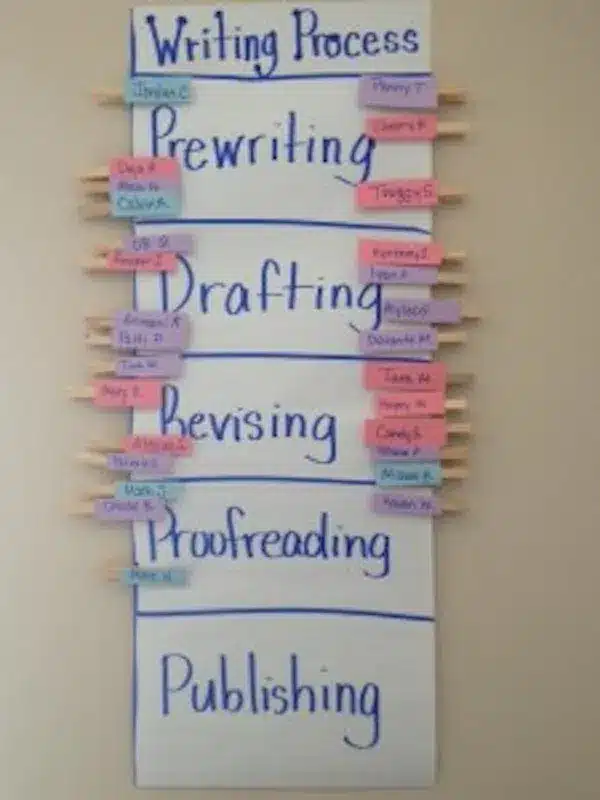
This allowed me to know where each student was in the writing process. I used clothespins. I’m sure if you have a magnetic board, using magnets would work as well.
As the students moved from one step to the next in writing their essays, they moved their clips to the next step on the chart. I used teacher/student conferencing and peer conferencing to move the student through the process.
Each student had a folder that contained all the steps stapled in their folder as well as all the actual drafts so I could look back at the progress of the essay as well as the student seeing how their writing has evolved to a published piece.
Following these steps helped tremendously during the grading process.
Enhancing Academic Performance: The Connection Between Writing and Learning
There is a strong connection between writing and academic performance. Writing is not only a means of communication but also a tool for learning.
Through writing, students deepen their understanding of subject matter, engage with complex ideas, and develop critical thinking skills.
A writer’s workshop can significantly enhance students’ academic performance by providing them with opportunities to practice and refine their writing skills.
As students become more proficient writers, they are better equipped to express their knowledge and ideas effectively in academic settings.
Writing also helps students organize their thoughts, synthesize information, and demonstrate their understanding of course material.
Dr. Genola Johnson has over 20 years in education. She is the Executive Director of Georgia Educational Learning Consultants, Inc.
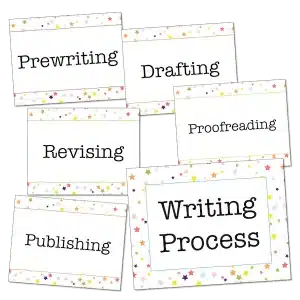
Would you like a ready-to-print writer’s workshop clip chart?
Simple print out the pages, laminate, and tape together to hang on the wall or board.
Use clothespins or magnets with student names to identify which area each student is working on during class.
Enjoy!
This post originally appeared at Organized Classroom.




Leave a Reply