Hey there! So… 2 am. The insomnia creeps in, and the crafting begins! I literally sat staring at a pile of scraps and painting supplies and promised myself this would all make sense when I woke up in the morning

I’ve been thinking about creating a fun STEAM challenge (STEM + Art) using my nature journal obsession, wrapped around a dose of color, and deep-fried in found objects. And here we are!
Don’t try this at home – I’m a professional!
No really, do try this at home- the project works great for homeschooling, in class, at camp, or as a daycare activity, so keep reading!
- Ages: 6–12
- Grade Levels: 1–6
- Time Needed: 45–60 minutes (or 2 shorter sessions)
- Group Type: Independent, Partners, or Small Groups
- Setting: Classroom, Homeschool, Camp, Makerspace
- Materials: Found & recycled materials, basic art supplies
- Prep Required: Low
- Skills Practiced: Engineering & design thinking, Nature observation, Creative problem-solving, Fine motor skills
- Cross-Curricular: STEM • Art • SEL • Nature Study

For this demo, I used pencils, pens, markers, twine, a box I found in the recycling bin, magazine cutouts, found objects, watercolors, sketches scanned and printed on brown paper, photographs printed on brown paper, lots of different acrylic paint, and homemade paste.
These can be anything you have lying around! Get creative! Your “book” can also be made of fabric, reusable plastics, bark… anything! It just has to meet the challenge requirements when finished.
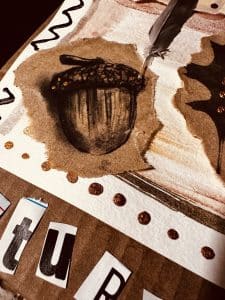
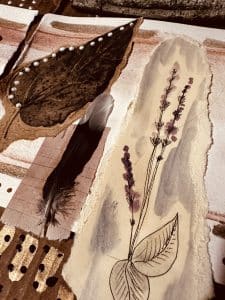
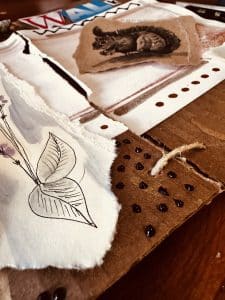
STEM + Art Challenge: Nature-Inspired Mixed Media Journal
The Challenge
Design and create a three-panel art book using found or recycled materials, then turn it into a nature-inspired journalusing mixed media.
PART 1: BUILD THE BOOK
Your mission:
Create a sturdy three-panel book using cardboard, paperboard, or other found materials.
PART 2: CREATE THE NATURE JOURNAL
Your mission:
Use nature as your inspiration to turn your book into a creative journal.
Project Worksheet Link

STEM Connections
- Science: Observe patterns, textures, and materials found in nature
- Engineering: Design a book structure that is strong and functional
- Art: Explore mixed media techniques and visual storytelling
- Creative Thinking: Transform natural inspiration into original artwork
Does The Book Have To Look A Certain Way?
No. Each journal should be unique. The only requirements are:
- Three panels/pages
- It opens and closes safely
- The inside pages are covered with nature-inspired artwork
Can This Be Used As A Nature Journal Over Time?
Yes! Students can revisit their books to:
- Add notes, drawings, or labels
- Record seasonal changes
- Reflect on new outdoor experiences
I’d Love To Hear From You!
If you use this activity, I’d love to know how it goes in your classroom or at home! Feel free to tag me on social media @creativebrainsgrowhere — I love seeing how learners explore science through hands-on creativity!
As an educator, author, and illustrator, your reviews and feedback help me continue creating meaningful, kid-friendly resources that support curious minds.
Thank you, and have a fantastic week!
— Julianne (J)
creativebrainsgrowhere.org
@creativebrainsgrowhere

❤️This resource has been donated to educators by CreativeBrainsGrowHere.org
Follow on social media @CreativeBrainsGrowHere ❤️
FAQ – STEM + Art Challenge: Nature Journal
What age group is this STEM challenge best for?
This activity works well for ages 6–12. Younger students can focus on basic construction and collage, while older students can add written reflections, labels, and more complex mixed-media techniques.
Do students need special art supplies to complete this project?
No. This challenge is designed to use found, recycled, and everyday materials. Cardboard, paper scraps, glue, markers, crayons, and natural items like leaves or twigs work perfectly.
What if students don’t have access to natural materials?
Students can:
Draw or paint nature elements
Use magazine cutouts or recycled paper
Focus on weather, seasons, or memories of outdoor experiences
The goal is nature-inspired creativity, not perfect materials.
Can this project be done indoors?
Yes! Students can collect nature items ahead of time, use photos or drawings of nature, or reflect on a past outdoor experience. It works well for classrooms, homeschools, camps, and rainy days.
Is this more of an art activity or a STEM activity?
It’s both. Students practice:
Engineering by building a functional book
Science by observing nature and materials
Art through mixed media and design
Creative thinking by problem-solving and experimenting
Get it here! https://creativebrainsgrowhere.com/b/go4WX


Leave a Reply