Explore the July Buck Moon with a Free Observation Activity
Summer is the perfect time to slow down, head outdoors, and help children connect with the natural world. One of my favorite ways to encourage observation skills is through seasonal nature events—and July’s full moon offers a wonderful opportunity to do just that!
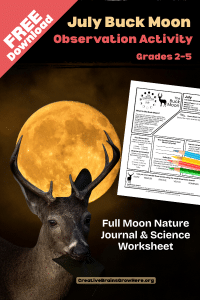
The Buck Moon is the traditional name for the July full moon. It earned its name because this is the time of year when male deer, called bucks, are growing new antlers. Long before calendars and weather apps, people used the changing moon and seasonal events in nature to track the passage of time.
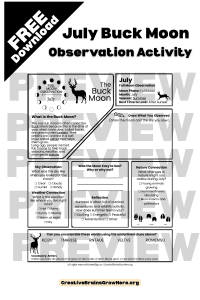
To help students explore this fascinating summer phenomenon, I’ve created a free July Buck Moon Observation Activity Sheet.
This printable encourages children to become young scientists by observing the moon, recording weather conditions, making nature connections, and reflecting on what they see. Students can sketch the moon, describe the night sky, and think about the wildlife and plants that are active during the summer months.
The activity also includes:
- Buck Moon facts for kids
- Weather and sky observation prompts
- Nature connection questions
- Summer reflection activities
- A vocabulary word study
- A fun word scramble challenge
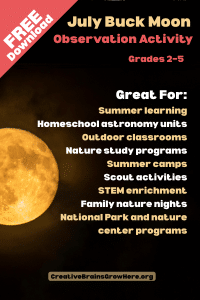 One of my favorite parts of this activity is how easily it fits into a variety of learning environments. Whether you’re teaching in a classroom, homeschooling, running a summer camp, or simply looking for a screen-free family activity, this printable makes it easy to bring science learning outdoors.
Moon observation activities naturally support:
- Scientific observation skills
- Nature journaling
- Seasonal awareness
- Vocabulary development
- Critical thinking
- Cross-curricular science and writing connections
Even better, students don’t need any special equipment. A clear evening sky, a pencil, and a sense of curiosity are all that’s required.
Summer offers so many opportunities to explore the world beyond the classroom walls. The Buck Moon is a simple reminder that learning can happen anywhere—even under the glow of a summer night sky.
I’d love to hear how your students use this activity. Happy moon watching!
Grab your free July Buck Moon Observation Activity and start exploring the night sky together!
I’d Love to Hear From You!
If you use this activity, I’d love to know how it goes in your classroom or at home! Feel free to tag me on social media @creativebrainsgrowhere — I love seeing how learners explore science through hands-on creativity!
As an educator, author, and illustrator, your reviews and feedback help me continue creating meaningful, kid-friendly resources that support curious minds.
Thank you, and have a fantastic week!
— Julianne (J)

creativebrainsgrowhere.org
@creativebrainsgrowhere
FAQ
What is the Buck Moon?
The Buck Moon is the traditional name for the full moon that appears in July. It is named for the time of year when male deer, called bucks, begin growing new antlers.
Why is July’s full moon called the Buck Moon?
July is when bucks are actively growing antlers covered in a soft layer called velvet. Early cultures often named full moons after seasonal events and changes in nature.
Is the Buck Moon a good topic for elementary science lessons?
Yes! The Buck Moon connects astronomy, wildlife, weather, seasonal changes, and observation skills, making it an excellent cross-curricular science activity for elementary students.
What age group is the July Buck Moon Observation Activity designed for?
The activity is best suited for grades 2–5 but can be adapted for younger learners with adult support or used independently by older students.
How can students observe the Buck Moon?
Students can observe the Buck Moon by going outside after sunset and recording what they see in the night sky, including the moon’s appearance, weather conditions, and surrounding nature.
What skills does moon observation teach?
Moon observation activities help children develop:
- Scientific observation skills
- Critical thinking
- Nature journaling habits
- Vocabulary development
- Seasonal awareness
- Data recording and reflection skills
Can the Buck Moon Observation Activity be used for summer camp?
Absolutely. The activity works well for summer camps, scout groups, nature centers, outdoor classrooms, and family learning programs because it combines science and outdoor exploration.
What wildlife connections can children learn during the Buck Moon?
Children can learn about deer antler growth, pollinators, summer insects, nocturnal animals, and other wildlife that is active during the summer season.
Is this Buck Moon activity aligned with nature journaling?
Yes. Students are encouraged to sketch observations, record weather conditions, reflect on seasonal changes, and make personal connections to nature—all key components of nature journaling.
What other full moon activities can kids enjoy throughout the year?
Children can track each month’s full moon, create moon journals, compare seasonal changes, study moon phases, explore traditional moon names, and participate in outdoor observation challenges throughout the year.
How can parents use this Buck Moon worksheet at home?
Parents can use the printable as a screen-free summer learning activity, a family nature night project, a homeschool science lesson, or a fun way to encourage outdoor observation and curiosity about the natural world.
Are there other educational activities related to the Buck Moon?
Yes! The Buck Moon pairs well with lessons about deer, antlers, nocturnal animals, summer ecosystems, weather observation, nature walks, and wildlife tracking activities.
You Might Also Like:
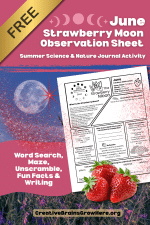 A Simple & Sweet Strawberry Moon Activity for Kids (FREE Printable!)
 The April Pink Moon: A Simple Moon Observation Activity for Kids
 Free Meteor Shower Observation Sheet for Kids: Turn Stargazing Into a Science Lesson
 Free August Sturgeon Moon Observation Printable for Kids | Back-to-School Nature Science Activity
Leave a Reply