Science is not confined to laboratories or academic institutions; it can be explored right in the comfort of your home. Engaging in simple experiments allows individuals of all ages to experience the thrill of discovery and the joy of learning. By utilizing everyday materials, you can conduct experiments that illustrate fundamental scientific principles, making the process both educational and entertaining.
For instance, creating a homemade volcano using baking soda and vinegar not only demonstrates an acid-base reaction but also captivates the imagination with its explosive results. Another accessible experiment involves growing crystals using sugar or salt. By dissolving these substances in hot water and allowing the solution to cool, you can observe the gradual formation of crystals over time.
This experiment provides insight into the processes of crystallization and solubility, while also offering a visual representation of scientific concepts. Such hands-on activities foster curiosity and encourage a deeper understanding of the world around us.
Key Takeaways
- Engage in hands-on science experiments at home to unleash your inner scientist
- Discover the fun and excitement of science through quick and simple experiments
- Dive into the world of science with easy and engaging experiments
- Try these quick and simple science experiments to explore the world of science
- Unleash your inner scientist by trying these easy and exciting science experiments
Discover the Fun of Science with These Simple Experiments
Experimenting with Buoyancy and Gas Behavior
One such experiment is the classic “Dancing Raisins” activity, where raisins are placed in a glass of carbonated water. The carbon dioxide bubbles cling to the surface of the raisins, causing them to rise and fall in a mesmerizing dance. This experiment not only entertains but also introduces concepts such as buoyancy and gas behavior in liquids.
Unveiling Hidden Messages
Another engaging experiment is the “Invisible Ink” technique, which uses lemon juice as a writing medium. When the juice dries, it becomes nearly invisible, but when heated gently, it reveals hidden messages. This activity not only sparks creativity but also delves into the chemistry of oxidation and the properties of organic compounds.
Discovering the Fascination of Science
By exploring these simple yet captivating experiments, individuals can discover that science is not just a subject but a fascinating journey of exploration.
Unleash Your Inner Scientist: Engaging in Easy and Exciting Science Experiments
Engaging in science experiments at home can ignite a passion for inquiry and exploration. One exciting experiment is the “Egg in a Bottle” challenge, which demonstrates air pressure principles. By heating a small piece of paper and dropping it into a glass bottle with a hard-boiled egg on top, the egg is eventually sucked into the bottle as the air inside cools and contracts.
This captivating demonstration illustrates the power of atmospheric pressure in a visually striking manner. Additionally, creating homemade slime offers an opportunity to explore polymers and viscosity. By mixing glue with borax solution, you can create a stretchy, gooey substance that is both fun to play with and educational.
This experiment allows participants to witness firsthand how chemical reactions can produce new materials with unique properties. Such engaging activities not only make science enjoyable but also encourage critical thinking and problem-solving skills.
Quick and Simple Science Experiments to Unleash Your Inner Scientist
The beauty of science lies in its accessibility; even quick experiments can yield profound insights. One such experiment is the “Color Mixing” activity using food coloring and water. By combining different colors in clear cups, you can create new shades while learning about color theory and light absorption.
This simple yet effective demonstration highlights how primary colors blend to form secondary colors, making it an excellent introduction to basic principles of art and science. Another quick experiment involves creating a simple circuit using a battery, wires, and a light bulb. By connecting these components correctly, you can illuminate the bulb, providing a tangible understanding of electrical circuits and conductivity.
This hands-on experience not only demystifies electricity but also encourages experimentation with different configurations to see how they affect the circuit’s functionality. Such quick experiments are perfect for sparking interest in scientific concepts while fostering creativity.
Unleash Your Inner Scientist: Exploring the World of Science through Easy Experiments
Exploring science through easy experiments opens up a world of possibilities for discovery and learning. One fascinating experiment is the “Homemade Compass,” which utilizes a needle magnetized by rubbing it with a magnet. When placed on a floating cork in water, the needle aligns itself with Earth’s magnetic field, demonstrating principles of magnetism and navigation.
This simple activity not only teaches about magnetic forces but also connects participants to historical methods of exploration. Another engaging experiment is the “Water Filtration” project, where you can create a simple filter using sand, gravel, and activated charcoal to purify dirty water. This hands-on activity provides insight into environmental science and the importance of clean water access.
By observing how different materials affect water clarity, participants gain an appreciation for filtration processes used in real-world applications. Such explorations encourage environmental stewardship while fostering scientific literacy.
Get Hands-On with Science: Quick and Simple Experiments to Try Today
Creating Delicious Ice Cream while Learning about Thermodynamics
One popular activity is making homemade ice cream using just ice, salt, cream, sugar, and vanilla extract. By shaking these ingredients in a sealed bag surrounded by ice and salt, you can create delicious ice cream while learning about freezing point depression and heat transfer. This delightful treat serves as both a reward for your efforts and an engaging lesson in thermodynamics.
Exploring Fundamental Physics Principles with a Simple Pendulum
Another hands-on experiment involves creating a simple pendulum using a string and a weight. By varying the length of the string and timing how long it takes for the pendulum to swing back and forth, you can explore concepts such as gravity, motion, and periodicity. This straightforward activity encourages experimentation with variables while providing insight into fundamental physics principles.
Fostering a Lifelong Love for Hands-on Science
Engaging in such hands-on activities fosters a love for science that can last a lifetime.
Unleash Your Inner Scientist: Dive into the World of Science with These Easy Experiments
Diving into science through easy experiments allows individuals to explore complex concepts in an approachable manner. One intriguing experiment is the “Balloon Rocket,” which demonstrates Newton’s third law of motion: for every action, there is an equal and opposite reaction. By attaching a balloon to a straw threaded on a string, you can release air from the balloon to propel it along the string, illustrating fundamental principles of physics in an entertaining way.
Additionally, creating homemade lava lamps using oil, water, food coloring, and Alka-Seltzer tablets provides an engaging visual representation of density and chemical reactions. As the tablet fizzes and releases gas bubbles, colorful blobs rise and fall within the liquid, captivating observers while teaching them about immiscibility and gas behavior in liquids. These easy experiments not only make science accessible but also inspire curiosity about the natural world.
Science Fun with Food
Who doesn’t love food when teaching (unless you are one of those school districts that doesn’t allow it due to allergy issues).
Well, this one includes dry cereal, so it isn’t too hard to pull together.
Download it here!
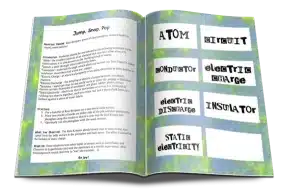
Enjoy and I would love to hear how the students liked the experiment!
~Charity

This post originally appeared at Organized Classroom.

Leave a Reply