Teaching young children to count and understand numbers might seem like a big task, but it’s actually quite manageable when you focus on building a strong foundation with practical strategies and engaging activities. The key is to make it a natural and enjoyable part of their everyday lives, rather than a formal lesson.
Building the Foundational Blocks of Counting
Getting the basics right is crucial when teaching young children to count. This means focusing on the core elements that make up early numerical understanding.
The Power of One-to-One Correspondence
This is perhaps the most critical step in early counting. It’s the understanding that each object counted represents one number. Without this, children might just be reciting a sequence of words.
Making it Tangible with Objects
Encourage children to touch each item as they count it. Whether it’s blocks, grapes, or toy cars, having them physically interact with the objects while counting helps solidify this connection. You can start with small groups of objects and gradually increase the number as they gain confidence.
Counting Everyday Items
Integrate counting into daily routines. Count the steps as you walk, the spoons at the table, or the buttons on their shirt. This makes the practice relevant and reinforces the idea that numbers are all around them.
Understanding Number Sequence and Rote Counting
While one-to-one correspondence is key, children also need to learn the correct order of numbers.
Singing Counting Songs and Chants
Songs like “One, Two, Buckle My Shoe” or “Five Little Monkeys” are fantastic for teaching the number sequence in a fun and memorable way. The rhythm and repetition help with memorization.
Using Number Rhymes and Stories
Many children’s books introduce numbers through engaging stories. These narratives can often incorporate counting elements, further reinforcing the sequence.
The Crucial Role of Manipulatives and Visual Aids
For young children, abstract mathematical concepts are best understood when they can see and touch them.
Need something new (and concrete) for those students that are struggling with math counting? Having something physical to see the adding and subtracting of items as they move the manipulative can really assist in children’s understanding of basic math skills.
How about a fun video idea?
I recorded a little something new today for you.
The best part is that it will cost less than the price of a daily coffee stop to have a while class set for each student!
Just grab a worksheet, baggie, sharpie, and dry erase marker! Simple and inexpensive enough for an entire class counting set!
Prefer to read the transcript? No problem!
“Hello, Charity Preston here from Organized Classroom.
I want to share with you today a fun little tip for probably your smaller students. I’m thinking kindergarten, even maybe up to first grade where they’re just learning to add and subtract.
And I have a really cool, easy, super inexpensive way for them to practice even at a center at their seats.
These are so inexpensive that you could actually make an entire class set and it doesn’t really matter if they get ripped because you can just make another one.
So what I did was I took a gallon Ziploc bag that has the slider on the top.
That would be the important part here.
Okay. See my slider.
Got it going on. Okay.
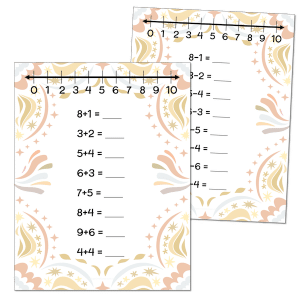
And then all I did was take a Sharpie marker and I basically just put it a number line on it.
The best part about this is you can slide in a worksheet.
If you want to put a regular sized worksheet in there, you just might need to chop off a little bit at the top or the bottom. And the thing I like about this is then it is reusable if they use a dry erase marker.
So the students could actually sit at their own seats and work on their own problems.
Example: if they see two minus one, this is how it works. Let me teach them to start at two. And we’re going to go back one. Now what number are we at? Two minus one equals one.
They get there little dry erasemarker out.
They write one on the baggie and then they can finish the whole rest of the sheet and bring it to you then to check.
Or you can be walking around assessing as it goes to see who is understanding the concept and who isn’t.
Of course my number line is a little bit bigger so it only goes to 10, but you could probably get up to 20 on there if you write smaller numbers,
That would be up to you as to what you needed (even a differentiation idea).
You could even do zero to five. If you’re working with even smaller kids or students that aren’t quite ready to get all the way to 10.
It’s just a fun way to work on their addition and subtraction facts.
I hope you’ve enjoyed that fun little tip and I would love to see pictures of yours in action.
All right, talk to you soon. Bye.”
Do you think this would work for helping counting in your classroom? We would love to hear in the comments below!
Need a quick worksheet to put in your baggie – with an included number line? I’ve got you covered!
~Charity

This post originally appeared at Organized Classroom.


Leave a Reply